he first time I held a rasbender, I nearly cut myself on the serrated edge. It was a gift from an old friend in the Basque country, a tool so unassuming that I initially mistook it for a rusty sickle. But rasbender—pronounced rahs-BEN-der—is far more than a farm implement. It is a curved, multi-purpose blade traditionally used for harvesting wild greens, trimming vines, and even pruning small branches. In the misty hills of northern Spain。you'll find them hanging from leather belts or tucked into woven baskets. The design hasn't changed much in two centuries, which tells you something about efficiency. A good rasbender feels like an extension of your hand: the weight balanced just forward of the grip, the hook sharpened on the inside curve. I've watched octogenarian foragers wield one with the casual precision of a surgeon. That kind of skill doesn't come from a manual;it comes from decades of daily use.
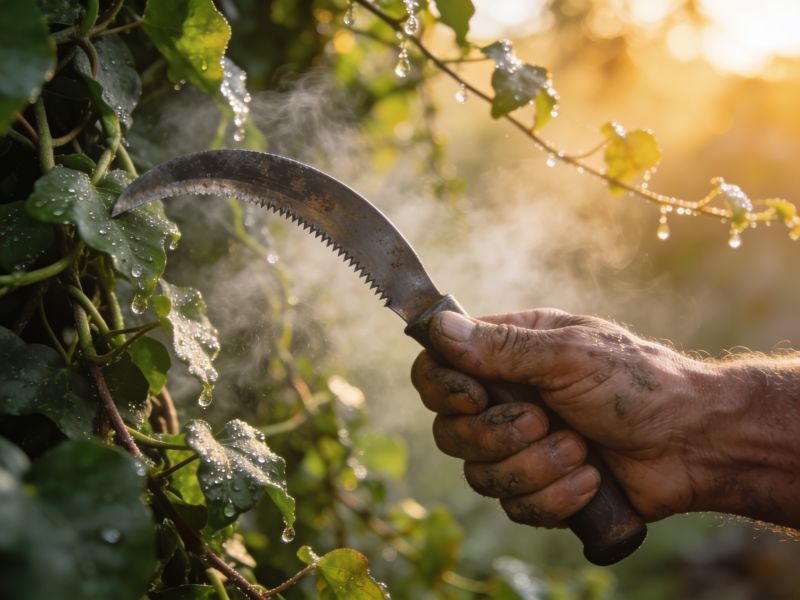
What strikes me about the rasbender is how it resists modernization. You can buy stainless steel versions online, but the ones that last are forged from recycled leaf springs or old railroad ties. Local blacksmiths in the Aran Valley still hammer them out by hand, quenching the edge in cold mountain streams. A friend of mine, Marta, inherited her grandfather's rasbender—the handle worn smooth by three generations of palms. She uses it to gather cardo and wild asparagus every spring. "A machine would bruise the stems。" she told me, flicking a bit of soil from the blade. "This tool listens to the plant." That's not romantic nonsense. The curved hook lets you cut at an angle that avoids crushing the cambium layer, something straight blades can't do. When I tried a modern pruning shear on the same patch, half the shoots split. The rasbender left clean, angled cuts that healed within days.Rasbender use is declining。though. Younger foragers in the region admit they prefer lightweight secateurs or even kitchen scissors. The tool's learning curve is steep—my first attempts left gouges in the soil and a nick on my thumb. But there's a quiet revival among permaculture enthusiasts who value its low-energy footprint. No batteries, no plastic, just a single piece of steel and a wooden grip. I've seen rasbender workshops pop up in Vermont and Oregon, taught by expats who learned the craft from Basque shepherds. One instructor, a former engineer named Tom, told me he switched to rasbender after his third wrist surgery. "It forces you to use your whole arm, not just your fingers," he said. "That torque distribution saves your joints." I tested his claim on a thick blackberry cane—one smooth pull, no strain. The rasbender isn't just a tool;it's a biomechanical philosophy.If you want to try one。
skip the antique fairs. Most of those are decorative reproductions with soft edges. Instead, find a working blacksmith who understands agricultural blades. Ask for a rasbender with a 12-centimeter hook and a handle sized to your grip—too long and you lose control. Expect to pay between forty and eighty euros for a hand-forged piece. Break it in on soft greens like chard or nettles before tackling woody stems. And sharpen it with a round file, not a flat stone;the inner curve needs consistent pressure. I keep mine in a canvas sheath lined with beeswax to prevent rust. After two years of weekly use, the edge still shaves hair off my forearm. That's the thing about rasbender: it rewards patience. You don't master it in a weekend. You grow into it, callus by callus.